
 Контакт
 Как се пазарува?

Доставка
Наръчник за пазаруване
AI for Power Electronics Engineers
Practical AI-Assisted Workflows for Power Conversion, Semiconductor Selection, Magnetics, Control, PCB Layout, EMI/EMC, Thermal Design and Simulation
 Английски език
 63 b
 Подготвяме
 Нови
До 30 дни за връщане на стоки

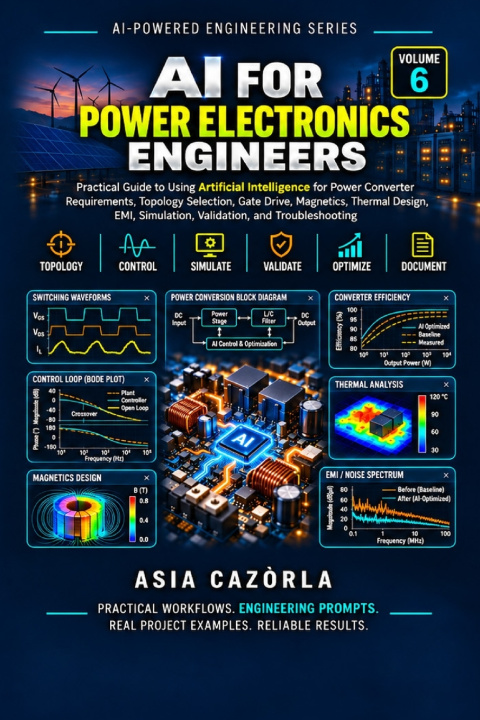
AI for Power Electronics Engineers
Volume 6 of The AI-Powered Engineering Series
Higher efficiency. Better power stages. Smarter validation. Faster engineering decisions.
Power electronics design combines semiconductor behavior, magnetics, control, thermal management, PCB parasitics, EMI, reliability, and laboratory validation. As switching frequencies increase and SiC and GaN technologies become more common, interactions between these domains become increasingly important.
AI for Power Electronics Engineers presents a practical methodology for integrating Artificial Intelligence into the complete power-electronics development workflow while keeping engineering analysis, simulation, measurement, and human technical authority at the center of every decision.
The objective is not to replace the engineer, but to use AI to accelerate requirements analysis, compare design alternatives, expand review coverage, organize technical evidence, investigate failures more systematically, and improve documentation.
This book covers AI-assisted workflows for:
• Requirements and Architecture - define voltage, current, power, efficiency, isolation, thermal, EMI, reliability, size, and cost targets.
• Converter Topology Selection - compare Buck, Boost, Buck-Boost, isolated bridges, phase-shift full bridge, LLC resonant converters, Dual Active Bridge, and other architectures.
• Power Semiconductor Selection - evaluate MOSFET, IGBT, SiC, and GaN technologies using switching loss, conduction loss, thermal behavior, package parasitics, and operating stress.
• Gate Drive and Switching Behavior - analyze dead time, Miller effects, ringing, isolation, protection, and switching-speed tradeoffs.
• Magnetics Design - review transformers, inductors, core materials, saturation, leakage inductance, winding structure, losses, and thermal limits.
• Control and Stability - structure averaged models, loop analysis, compensation, dynamic response, and digital control.
• Efficiency and Thermal Design - connect switching, conduction, magnetic, passive, and auxiliary losses to junction temperature, heatsinks, cooling, and reliability.
• PCB Layout and Parasitics - identify critical commutation loops, DC-link placement, return paths, busbar geometry, grounding, and parasitic inductance.
• EMI and EMC - analyze common-mode and differential-mode noise, coupling paths, filters, cable currents, shielding, and pre-compliance testing.
• Simulation and Model Fidelity - combine analytical estimates, averaged models, switching models, semiconductor and magnetic models, 2.5D/3D EM extraction, and electrothermal simulation.
• Laboratory Validation - structure oscilloscope measurements, double-pulse testing, power analysis, thermal imaging, LISN measurements, current probes, and controlled test procedures.
• Troubleshooting and Root-Cause Analysis - use AI to rank hypotheses involving gate drive, commutation loops, magnetics, control, thermal behavior, EMI, and measurement setup.
The book also includes an end-to-end power-converter case study, reusable AI prompt frameworks, review checklists, validation strategies, model-fidelity workflows, and a view of the Future AI-Assisted Power Electronics Workstation.
AI structures the engineering workflow. Specialized tools calculate the physics. Measurements provide the evidence. Engineers retain final authority.
Part of The AI-Powered Engineering Series, this volume connects power electronics with PCB design, embedded systems, signal integrity, EMC, simulation, validation, and the broader AI-assisted engineering digital thread.


Информация за книгата
Английски език

Подарете тази книга днес
Лесно е
1 Добавете книгата в количката си и изберете Доставка като подарък 2 В замяна ще ви изпратим ваучер 3 Книгата ще пристигне на адреса на получателяЗдравейте! Аз съм Libroamiko, вашият книжен съветник.
Как мога да ви помогна?