
 Контакт
 Как се пазарува?
Доставка
Наръчник за пазаруване
 Английски език
 70 b
70 b
 Подготвяме
 Нови
Нови
До 30 дни за връщане на стоки

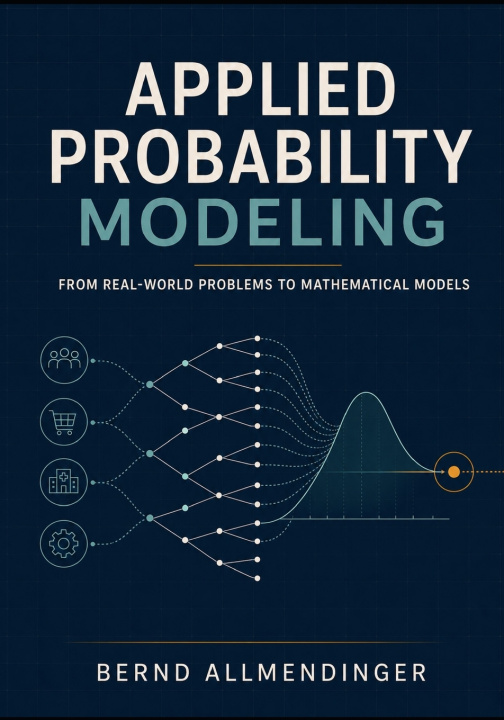
How do you turn a real-world problem into a clear and useful probability model?
Applied Probability Modeling: From Real-World Problems to Mathematical Models provides a practical, mathematically rigorous guide to building probability models from rules, assumptions, and observable mechanisms. Rather than presenting probability theory as a collection of isolated formulas, the book shows how those formulas arise-and how they can be used.
Each model is developed step by step:
• What is the real problem?
• Where does randomness enter?
• Which random variables are required?
• Why are probabilities multiplied, summed, conditioned, or integrated?
• Can the result be expressed in closed form?
• How should the result be interpreted and used?
• Under which assumptions does the model break down?
The book places particular emphasis on transparent derivations, generating functions, conditioning arguments, probability trees, convolution, Markov chains, dynamic programming, survival models, and Monte Carlo methods. Closed-form solutions are used whenever they improve understanding, while numerical methods and simulation are introduced only when the structure of the problem requires them.
Detailed applications include archery, tennis, soccer, darts, bowling, curling, table tennis, fencing, snooker, racing, reliability, queueing, insurance, finance, weather, quality control, cybersecurity, and project and supply-chain risk.
Readers learn how to move from individual events to complete games, systems, portfolios, queues, or networks-and how to translate the resulting probabilities into practical decisions.
This is not an introductory course in probability or statistics. It is written for readers who already understand elementary probability, random variables, expectation, variance, basic statistics, and integration, and who now want to learn how to apply those tools to realistic modelling problems.
More than 500 chapter exercises with complete solutions reinforce the modelling process, mathematical derivations, interpretation, validation, and sensitivity analysis.
The central message remains simple:
A model is not reality-but a carefully constructed model can make uncertainty understandable, measurable, and useful.


Информация за книгата
Английски език
