
 Контакт
 Как се пазарува?
Доставка
Наръчник за пазаруване
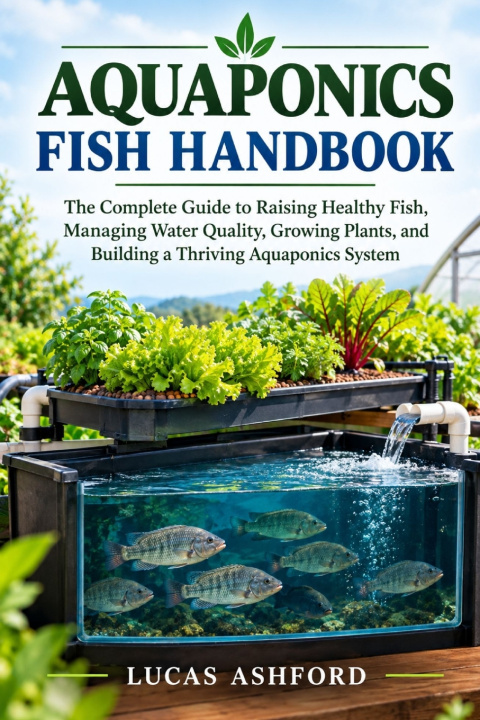
AQUAPONICS FISH HANDBOOK
The Complete Guide to Raising Healthy Fish, Managing Water Quality, Growing Plants, and Building a Thriving Aquaponics System
 Английски език
 35 b
35 b
 Нови
Нови
До 30 дни за връщане на стоки

Aquaponics Fish Handbook provides a practical introduction to raising fish within an integrated aquaponics system, where fish, plants, beneficial bacteria, water, and filtration work together as a living production cycle.
The book begins by explaining the fundamentals of aquaponics and how fish waste is transformed by beneficial bacteria into nutrients that plants can use. It then examines important fish choices, including considerations such as species, temperature requirements, growth characteristics, feed availability, stocking levels, and local market demand.
The handbook also explains how to design and establish an aquaponics system. Fish tanks, pumps, plumbing, filtration, aeration, growing areas, water circulation, system cycling, and emergency planning are discussed as essential elements of a reliable setup.
Water quality receives particular attention because it directly affects fish, plants, and beneficial microorganisms. Temperature, pH, ammonia, nitrite, nitrate, dissolved oxygen, water clarity, and source-water quality are explored alongside practical monitoring and management principles.
Feeding is another major part of successful fish production. The book explains how to select appropriate feed, establish sensible feeding routines, avoid overfeeding, monitor appetite, and understand the relationship between feed consumption, fish growth, and water quality.
Fish health and disease prevention are also covered. Readers learn how to recognize unusual behavior, reduce stress, manage stocking density, quarantine new fish, maintain equipment, and respond appropriately when disease or water-quality problems are suspected.
As fish grow, their increasing biomass places greater demands on oxygen, filtration, and water quality. The handbook therefore explains growth monitoring, stocking management, grading, record keeping, and the importance of maintaining balance between fish production and plant capacity.
The plant side of aquaponics is explored through nutrient cycling, crop selection, root health, lighting, plant density, harvesting, and nutrient management. The book emphasizes that healthy plant growth depends on maintaining the entire fish-bacteria-plant relationship rather than focusing on any single component.
Daily and weekly management routines help keep the system stable. Regular fish observation, water testing, equipment inspection, filter maintenance, plant monitoring, feeding records, and emergency preparation are presented as essential habits.
The handbook also introduces fish breeding, fingerling selection, nursery management, grow-out production, and continuous stocking strategies. These practices can help farmers develop a more organized production cycle while avoiding uncontrolled increases in fish biomass.
Harvesting and post-harvest handling are addressed with attention to fish welfare, product quality, cooling, processing, food safety, waste management, and maintaining system balance after fish are removed.
Finally, the book considers aquaponics as a potential business. It discusses production goals, startup and operating costs, market research, customer development, record keeping, risk management, expansion, and sustainability.
Overall, Aquaponics Fish Handbook demonstrates that successful aquaponics is based on balance and consistency. Healthy fish, appropriate feeding, stable water quality, active beneficial bacteria, productive plants, reliable equipment, careful record keeping, and responsible business management must work together.
With proper planning and continuous observation, aquaponics can provide an efficient and adaptable approach to producing fish and plants while making effective use of water and other resources.


Информация за книгата
Английски език

Подарете тази книга днес
Лесно е
1 Добавете книгата в количката си и изберете Доставка като подарък 2 В замяна ще ви изпратим ваучер 3 Книгата ще пристигне на адреса на получателяЗдравейте! Аз съм Libroamiko, вашият книжен съветник.
Как мога да ви помогна?