
 Контакт
 Как се пазарува?
Доставка
Наръчник за пазаруване
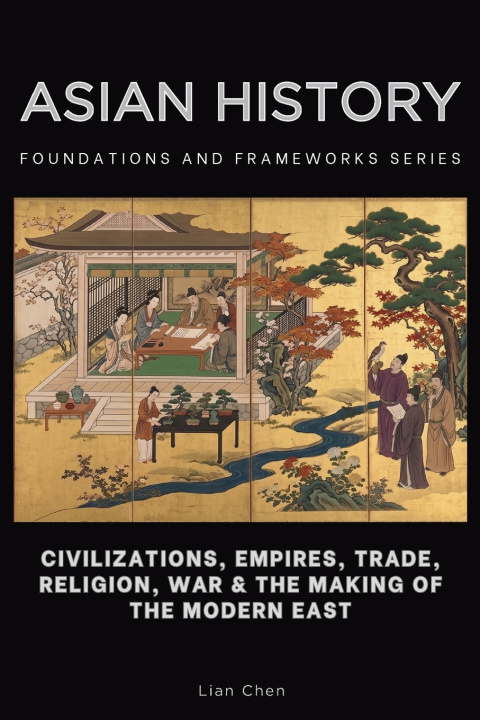
Asian History
Civilizations, Empires, Trade, Religion, War & the Making of the Modern East
 Английски език
 41 b
41 b
 Нови
Нови
До 30 дни за връщане на стоки

Asian history, told as one connected story instead of ten separate ones. Three thousand years across China, India, Persia, Japan, Korea, and Southeast Asia, arranged in the order it actually happened.
For most of the last two millennia, the wealthiest and most inventive societies on Earth sat east of the Mediterranean. Paper, gunpowder, the magnetic compass, and the numerals used for basic arithmetic all came from there first. China and India together produced more than half the world's economic output for centuries, right up to about 1800.
This book follows the civilizations, empires, faiths, and conflicts behind that record, moving straight through time so the links between regions stay visible rather than getting lost in a country-by-country account.
Ten chapters, in chronological order:
- The first farms, the Bronze Age states, and the brick cities of the Indus Valley, laid out with covered drains across a region larger than western Europe
- Qin unification by force, and the Han bureaucracy that ran China for four centuries after
- Ashoka's Mauryan Empire, the Gupta golden age, and the early kingdoms of Korea and Japan
- Hinduism, the life of Siddhartha Gautama, Confucian and Daoist thought in government, and Zoroastrianism under the Achaemenid Persians
- Tang and Song China: printing, paper money, and the goods and ideas that moved west along the Silk Road and across the Indian Ocean
- The rise of Islam and the early Caliphates, Muslim rule in Persia and Central Asia, the Delhi Sultanate, and the Southeast Asian trading kingdoms of Funan, Srivijaya, and the Khmer, who built Angkor Wat
- Genghis Khan, the Yuan and Ilkhanate, and the decades when one legal system stretched from Korea to the edge of Poland
- Ottomans, Safavids, Mughals under Akbar, and Zheng He's fleets, which carried ships several times the size of anything Columbus later sailed
- Tokugawa seclusion, the East India Company, the Opium Wars, and the Meiji Restoration that rebuilt Japan in a single generation
- Partition in 1947, the Chinese Civil War, Korea's division, Vietnam, the Four Asian Tigers, and Deng Xiaoping's economic reforms
No background in the subject is assumed. Each development sits in the sequence that explains it, which makes the book workable for students in world history courses, self-taught readers who want one volume instead of a shelf, and anyone trying to follow current events in the region with more than headline knowledge.
Five sections follow the final chapter: a conclusion, example answers to the discussion questions that close each chapter, a general timeline placing every major event in one sequence, a terms and definitions reference, and a works cited list with recommended reading. Read it front to back for the full picture, or open a single chapter on a period you care about and still follow it without backtracking.


Информация за книгата
Английски език

Подарете тази книга днес
Лесно е
1 Добавете книгата в количката си и изберете Доставка като подарък 2 В замяна ще ви изпратим ваучер 3 Книгата ще пристигне на адреса на получателяЗдравейте! Аз съм Libroamiko, вашият книжен съветник.
Как мога да ви помогна?