
 Контакт
 Как се пазарува?
Доставка
Наръчник за пазаруване
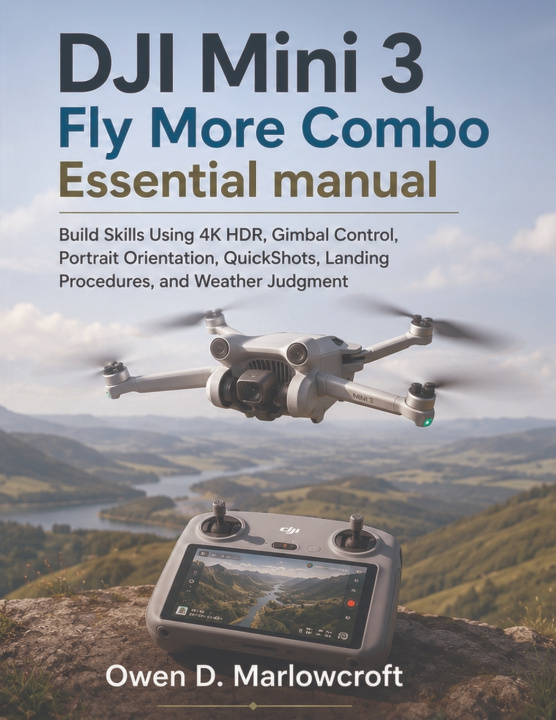
DJI Mini 3 Fly More Combo Essential manual
Build Skills Using 4K HDR, Gimbal Control, Portrait Orientation, QuickShots, Landing Procedures, and Weather Judgment
 Английски език
 50 b
50 b
 Нови
Нови
До 30 дни за връщане на стоки

The hardest part of a good drone flight is often not takeoff. It is knowing when the aircraft, camera, battery, wind, and landing area are all working in your favor.
DJI Mini 3 Fly More Combo Essential manual is designed around that judgment. Instead of treating 4K video, gimbal control, QuickShots, portrait capture, and landing as separate features, this guide shows how they fit together during a complete flight-from deciding whether conditions are suitable to bringing the aircraft back down without rushing the final seconds.
Inside, you'll learn how to:
• Prepare the aircraft, controller, batteries, storage, and gimbal before leaving the ground.
• Understand when the Mini 3 records 4K HDR video and how frame rate, exposure, movement, and light affect the finished footage.
• Use smoother stick and gimbal inputs so pans, tilts, reveals, and approach shots feel intentional rather than abrupt.
• Rotate into true vertical shooting when portrait-oriented content is the better choice.
• Set up QuickShots with enough open space and situational awareness to understand where the aircraft is likely to travel.
• Judge wind more carefully instead of treating a published wind-resistance figure as a guarantee that every flight is safe.
• Plan battery reserve, return timing, landing direction, and touchdown area before low power turns a routine landing into a rushed decision.
• Work through camera, gimbal, connection, positioning, storage, and flight-warning problems in a logical order.
• Inspect propellers, motors, batteries, ports, and the aircraft after use so small problems are noticed before the next flight.
DJI specifies a maximum wind-speed resistance of 10.7 m/s (Level 5) for the Mini 3, but actual flight behavior still depends on conditions, altitude, battery state, direction of travel, and the distance needed to return. The aircraft also uses a downward vision system rather than forward, backward, or side obstacle sensing. Those limits matter whenever an automated maneuver or landing area is being evaluated.
The camera supports 4K HDR recording at 24, 25, or 30 fps, a three-axis mechanical gimbal, five QuickShots, and true vertical shooting. This handbook turns those specifications into practical decisions about motion, framing, timing, and when not to press Record yet.
Practical input from three field personnel keeps the focus on repeatable flight habits, image-making, environmental judgment, and equipment care rather than a feature-by-feature rewrite of the manufacturer's manual.
Whether you want smoother aerial footage, cleaner portrait clips, more deliberate automated shots, or simply fewer uneasy landings, the objective is the same: fly with enough margin to think clearly.
Read the conditions before the props spin. Shape the shot while you still have options. And bring the aircraft home with the same care you used to launch it.
This is an independently produced third-party educational guide and is not affiliated with, sponsored by, endorsed by, or authorized by DJI. DJI, Mini 3, Fly More Combo, QuickShots, and other referenced names and trademarks belong to their respective owners. Features, accessories, firmware, flight restrictions, and regional requirements may change. Always consult the manufacturer's current documentation and comply with the aviation rules applicable where you fly.


Информация за книгата
Английски език

Подарете тази книга днес
Лесно е
1 Добавете книгата в количката си и изберете Доставка като подарък 2 В замяна ще ви изпратим ваучер 3 Книгата ще пристигне на адреса на получателяЗдравейте! Аз съм Libroamiko, вашият книжен съветник.
Как мога да ви помогна?