
 Контакт
 Как се пазарува?

Доставка
Наръчник за пазаруване
 Английски език
 50 b
 Подготвяме
 Нови
До 30 дни за връщане на стоки

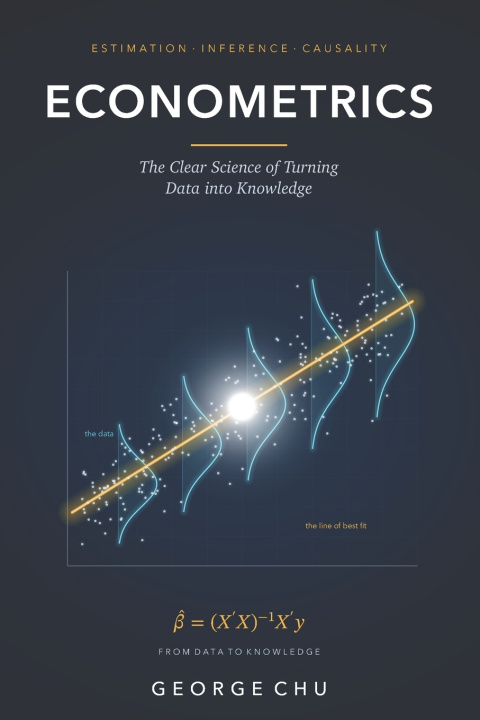
Every estimate is a sample moment set to zero. Every inference is about samples we did not draw. Every causal claim rests on a design. This book is what follows from those three sentences.
Econometrics has a reputation as a thicket of recipes: regressions with stars, assumptions with numbers instead of names, corrections for problems you did not know you had, and an alphabet of acronyms - 2SLS, GMM, VAR, DiD, RDD, DML. It need not be. Beneath the techniques lie three questions. What is the relationship? How sure can we be? Is it causal? And one idea unites every method: an estimator makes a sample moment equal zero, and its credibility rests on an argument that the population moment is zero too.
Twenty-four chapters. Six parts. Every key result derived step by step.
Part I - Foundations. What econometrics is, the conditional expectation as the best predictor, estimators and their virtues, the law of large numbers and the central limit theorem, tests, p-values, power and confidence intervals.
Part II - Regression. Least squares as moment estimator and projection, the Frisch-Waugh-Lovell theorem, omitted variable bias, the Gauss-Markov theorem, robust and clustered standard errors, the bootstrap, logs, dummies, interactions and quantile regression.
Part III - Causality. Potential outcomes and experiments, instrumental variables and LATE, weak instruments, panels and fixed effects, difference-in-differences rebuilt for staggered adoption, regression discontinuity, matching, propensity scores and synthetic control.
Part IV - Estimation principles. Maximum likelihood and its three tests, probit, logit, Tobit and Heckman selection, Poisson gravity models, and the generalised method of moments that unifies them all.
Part V - Time. Stationarity, ARMA models and forecasting, nowcasting, unit roots and spurious regression, cointegration and error correction, VARs, local projections and GARCH volatility.
Part VI - Frontiers. Machine learning and double machine learning, causal forests, structural demand estimation, Bayesian and empirical Bayes methods, and the movement for credible, replicable research.
Written to be understood. Every chapter opens with a question, builds the ideas one at a time, and closes with what has been established and problems to practise on. Worked examples use small data sets you can check with a pencil. Ninety-two figures - regression lines, sampling distributions, event studies, discontinuities, impulse responses - make each idea visible before the algebra arrives.
Current, not dated. The book draws on research from 2025 and 2026: the new estimators for difference-in-differences, the consensus that local projections and VARs share one target, double machine learning, prediction-powered inference for measurement from text, images and satellite data, and large-scale replication of published economics.
An optimistic book. Econometrics is how a society learns from its own experience. Its tools now turn noisy, accidental, observational data into reliable knowledge about which policies, programmes and markets really work - and the field is more transparent and better checked than ever.
Who it is for. Students of economics, finance, public policy and business; readers preparing for graduate study; data scientists who want causal inference done properly; and anyone who reads empirical claims and wants to judge them.
Inside you will find:
• 24 chapters in six parts, one connected argument
• 92 figures and diagrams, 26 tables, 88 numbered equations
• worked examples and problems in every chapter
• a formula reference, a glossary and a mathematical toolkit


Информация за книгата
Английски език

Подарете тази книга днес
Лесно е
1 Добавете книгата в количката си и изберете Доставка като подарък 2 В замяна ще ви изпратим ваучер 3 Книгата ще пристигне на адреса на получателяЗдравейте! Аз съм Libroamiko, вашият книжен съветник.
Как мога да ви помогна?