
 Контакт
 Как се пазарува?
Доставка
Наръчник за пазаруване
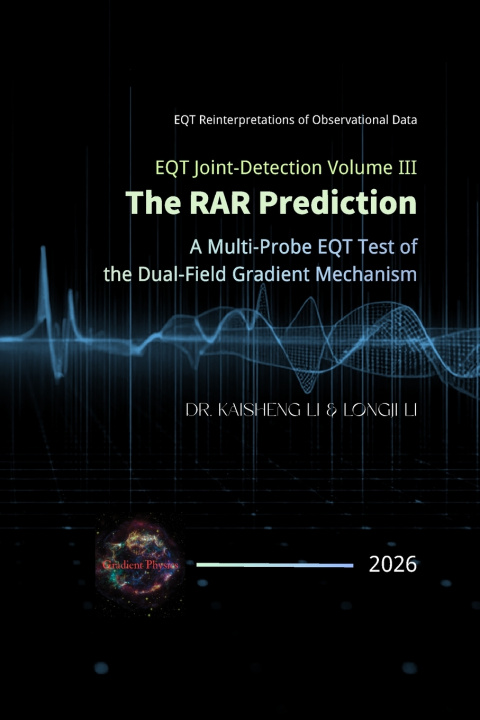
EQT Joint-Detection Volume III
The RAR Prediction}: A Multi-Probe EQT Test of the Dual-Field Gradient Mechanism
 Английски език
 68 b
68 b
 Нови
Нови
До 30 дни за връщане на стоки

This volume is the third book in the EQT series on the multi-instrument reinterpretation of observational data. Its central question is whether the radial acceleration relation (RAR) can be moved beyond post hoc dark-matter inversion and formulated as a mechanistic, falsifiable prediction. The RAR is one of the most striking regularities in galactic dynamics: observed accelerations depart from the Newtonian expectation based on baryons around a nearly universal acceleration scale, with small scatter and a smooth transition. Standard approaches describe this regularity either through dark-matter halos in ΛCDM or through a universal acceleration scale and interpolation function in MOND. Both are treated here as empirically successful reference frameworks, not as failed targets.
The EQT reading begins from an interface reclassification. The dark-matter-like enhancement inferred from rotation curves is not treated merely as an empirical residual, but is locked to the effective gravitational-coupling interface, so that the enhancement factor becomes a scale-dependent expression of (G_{\mathrm{eff}}(r)/G). This shifts the problem from "how much dark matter must be added after the fact?" to "what mechanism determines the scale dependence of effective gravitational coupling?" The book then develops the dual-field gradient mechanism: an ultra-low-frequency background field sets the universal acceleration scale, while a mid-frequency field determines the galaxy-by-galaxy enhancement amplitude. Their multiplicative coupling is used to reinterpret the RAR, its small scatter, and the smoothness of the transition radius.
The methodological premise is that single probes are underdetermined. A single galaxy rotation curve can usually be made compatible with an EQT dual-field reading, a MOND interpolation, or a ΛCDM halo model. Discriminating information lies instead in systematic relations across galaxies, scales, environments, and redshifts: whether the acceleration scale is universal, whether the transition radius follows (r_t \propto \sqrt{M_b}), whether residual scatter correlates with dynamical relaxation, whether lensing and cluster dynamics read out the same effective-coupling structure, and whether the acceleration scale shows a high-redshift turnover. These are multi-probe questions, not single-curve questions.
The volume proceeds from object foundations to cooperative detectability criteria, diagnostic matrices, reinterpretive verification, and falsifiable predictions. It introduces criteria for a universal acceleration scale, dual-field multiplicative coupling, and dynamic-steady-state handover; formulates diagnostic quantities such as (a^\dagger), (a^\dagger(z)), (r_t), enhancement factors, and scatter-relaxation correlations; and places SPARC rotation curves, lensing measurements, cluster dynamics, and high-redshift rotation data within a common testing framework. The core discriminating prediction is not that (a^\dagger) is numerically close to (cH_0), a relation noted in several traditions, but that a dual-field mechanism should generate testable patterns beyond MOND and halo fitting, especially a possible high-redshift turnover in (a^\dagger(z)).
The book is deliberately constrained in scope. It does not introduce new EQT postulates, reject the empirical achievements of MOND or ΛCDM, or reinterpret cosmological redshift. It also does not claim that the final forward calculation of individual galaxy rotation curves has already been completed. Its contribution is more precise: to recast the RAR as a multi-probe, mechanism-level prediction, to identify where EQT can be empirically distinguished from existing descriptions, and to state clear conditions under which the proposed dual-field mechanism would fail.


Информация за книгата
Английски език

Подарете тази книга днес
Лесно е
1 Добавете книгата в количката си и изберете Доставка като подарък 2 В замяна ще ви изпратим ваучер 3 Книгата ще пристигне на адреса на получателяЗдравейте! Аз съм Libroamiko, вашият книжен съветник.
Как мога да ви помогна?