
 Контакт
 Как се пазарува?

Доставка
Наръчник за пазаруване
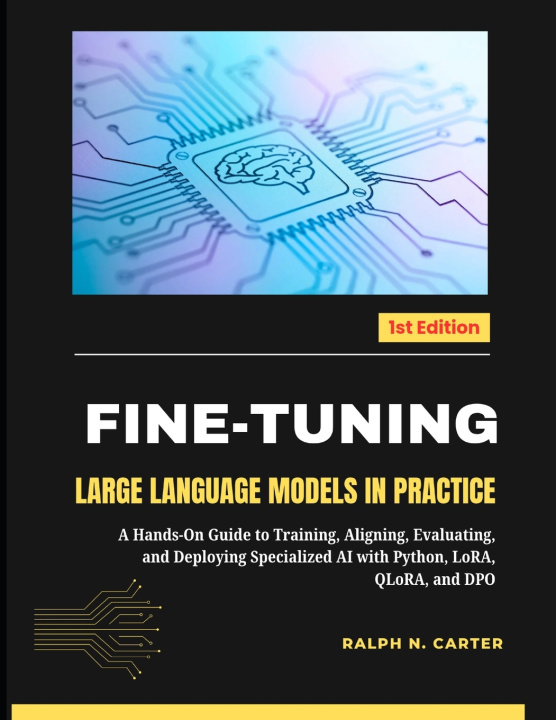
FINE-TUNING LARGE LANGUAGE MODELS IN PRACTICE
A Hands-On Guide to Training, Aligning, Evaluating, and Deploying Specialized AI with Python, LoRA, QLoRA, and DPO
 Английски език
 59 b
 Нови
До 30 дни за връщане на стоки

Your language model is powerful. But can it reliably perform the specialized tasks your application demands?
A pretrained large language model can generate impressive responses, yet struggle with domain-specific instructions, structured outputs, consistency, and specialized workflows. Fine-tuning offers a way to improve these capabilities-but how do you train a model effectively, reduce GPU costs, avoid common mistakes, and prove that your results are actually better?
FINE-TUNING LARGE LANGUAGE MODELS IN PRACTICE provides a comprehensive, hands-on guide to adapting pretrained language models into specialized AI systems using Python, supervised fine-tuning, LoRA, QLoRA, and Direct Preference Optimization (DPO).
Written for Python developers, AI engineers, machine learning practitioners, and technically minded professionals, this book takes you beyond isolated training scripts. It connects data preparation, model adaptation, evaluation, optimization, and deployment into a practical engineering workflow, with clear explanations, implementation examples, and real-world considerations.
Inside This Book, You'll Learn How To:
Master LLM fine-tuning fundamentals: Understand how language models learn, when fine-tuning makes sense, and how it compares with prompt engineering and retrieval-augmented generation (RAG).
Prepare high-quality training datasets: Collect, clean, structure, validate, and tokenize data while addressing leakage, privacy, licensing, and labeling quality.
Build practical training pipelines with Python: Work with PyTorch, Hugging Face Transformers, PEFT, TRL, and Accelerate to configure supervised fine-tuning workflows.
Apply LoRA and QLoRA effectively: Understand parameter-efficient fine-tuning, train lightweight adapters, and manage GPU memory and computational requirements.
Align models with human preferences: Explore DPO, preference datasets, and modern post-training techniques for improving model behavior.
Evaluate and optimize model performance: Design meaningful benchmarks, compare fine-tuned models against baselines, diagnose training failures, and test reliability.
Build specialized AI applications: Explore structured generation, tool calling, domain adaptation, knowledge distillation, and multimodal fine-tuning.
Deploy and maintain fine-tuned models: Learn model packaging, inference optimization, serving with vLLM and FastAPI, security testing, monitoring, and release management.
From Your First Fine-Tuning Experiment to Production-Ready Engineering Practices
What makes this guide valuable is its emphasis on the complete process-not just getting training code to run. You'll learn how to make informed technical decisions, recognize when results are misleading, manage resource constraints, and build reproducible workflows that support reliable AI development.
Whether you're adapting an open-weight model for a business application, developing a domain-specific AI assistant, or strengthening your practical machine learning skills, this book gives you the knowledge and tools to approach LLM fine-tuning with greater confidence and precision.
Stop relying on trial and error. Start building specialized language models with a structured, measurable approach.
Get your copy of FINE-TUNING LARGE LANGUAGE MODELS IN PRACTICE today and take your AI engineering skills from experimentation to practical implementation.


Информация за книгата
Английски език

Подарете тази книга днес
Лесно е
1 Добавете книгата в количката си и изберете Доставка като подарък 2 В замяна ще ви изпратим ваучер 3 Книгата ще пристигне на адреса на получателяЗдравейте! Аз съм Libroamiko, вашият книжен съветник.
Как мога да ви помогна?