
 Контакт
 Как се пазарува?
Доставка
Наръчник за пазаруване
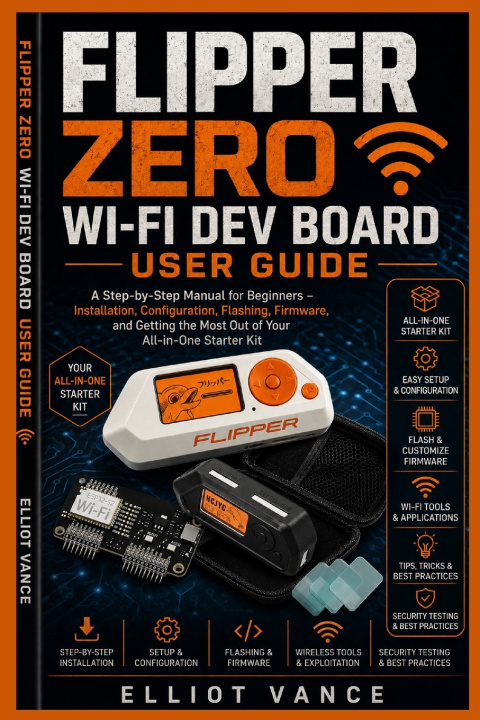
Flipper Zero Wi-Fi Dev Board User Guide
A Step-by-Step Manual for Beginners - Installation, Configuration, Flashing, Firmware, and Getting the Most Out of Your All-in-One Starter Kit.
 Английски език
 44 b
44 b
 Подготвяме
 Нови
Нови
До 30 дни за връщане на стоки

The Flipper Zero Wi-Fi Developer Board turns your Flipper into something considerably more capable: a wireless debugging tool, an ESP32-S2 development platform, and the entry point into one of the most active firmware communities built around any Flipper accessory. The problem is that almost nobody explains it clearly. Flipper's own documentation is written for developers who already know the toolchain. Tutorials online cover one step and leave you guessing at the rest. This book was written to fix that.
Flipper Zero Wi-Fi Dev Board User Guide takes you from an unopened box to a fully working, fully understood setup, without assuming any prior embedded development experience. It is built specifically around the ESP32-S2 hardware used in this board, including the bundled "All-in-One Complete Starter Kit" versions sold by third-party sellers, and every technical detail in it has been checked against Flipper's official developer documentation and the actual open-source firmware projects the board runs on.
You'll start with the fundamentals: what the board physically is, how it differs from the Flipper Zero's other GPIO accessories, and how to attach it correctly without bending a pin. From there, the book walks you through connecting over USB-C and Wi-Fi on Windows, macOS, and Linux, updating the board's firmware safely, and recovering it if a flash ever goes wrong.
Once your setup is working, the book goes further. A full chapter walks through a real wireless debugging session for Flipper Zero application development, start to finish. Another explains exactly how the community firmware ecosystem around this board, including Marauder, actually works, how to evaluate any firmware project before you trust it, and how to build firmware from source yourself with ESP-IDF if you want to go that far. You'll also find a beginner-friendly first GPIO project, a plain-language guide to reading Wi-Fi scan results, and a chapter dedicated to building a private test lab so you can learn hands-on without any legal ambiguity.
Because using this board responsibly matters as much as using it correctly, a full chapter lays out the legal and ethical boundaries of Wi-Fi testing tools in plain terms, so you know exactly where the line sits before you go looking for it.
The book closes with reference material built to last well past your first read-through: a troubleshooting chapter organized by symptom, a full glossary, a quick-reference command sheet, a first-setup checklist, and an index that sends you straight to the chapter that answers your question.
If you own this board, or you're deciding whether to, this is the guide that gets you there.


Информация за книгата
Английски език
