Контакт
 Как се пазарува?
Доставка
Наръчник за пазаруване
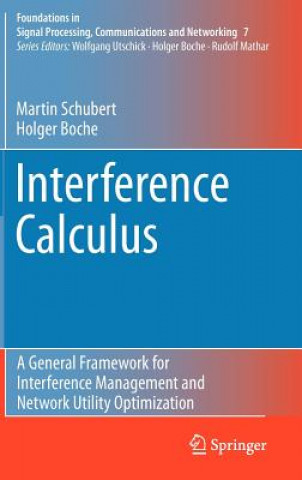
Interference Calculus
A General Framework for Interference Management and Network Utility Optimization
 Английски език
 263 b
263 b
30 дни за връщане на стоката
Клиентите са закупили също











 /
/
 С меки корици
 21.15
€
41.37 лв
21.15
€
41.37 лв




 /
С меки корици
21.26
€
41.57 лв
/
С меки корици
21.26
€
41.57 лв



This book develops a mathematical framework for modeling and optimizing interference-coupled multiuser systems. At the core of this framework is the concept of general interference functions, which provides a simple means of characterizing interdependencies between users. The entire analysis builds on the two core axioms scale-invariance and monotonicity. §The proposed network calculus has its roots in power control theory and wireless communications. It adds theoretical tools for analyzing the typical behavior of interference-coupled networks. In this way it complements existing game-theoretic approaches. §The framework should also be viewed in conjunction with optimization theory. There is a fruitful interplay between the theory of interference functions and convex optimization theory. By jointly exploiting the properties of interference functions, it is possible to design algorithms that outperform general-purpose techniques that only exploit convexity. §The title network calculus refers to the fact that the theory of interference functions constitutes a generic theoretical framework for the analysis of interference coupled systems. Certain operations within the framework are closed , that is, combinations of interference functions are interference functions again. Also, certain properties are preserved under such operations. This, provides a methodology for analyzing different multiuser performance measures that can be expressed as interference functions or combinations of interference functions.


Информация за книгата
Английски език
Категории

Подарете тази книга днес
Лесно е
1 Добавете книгата в количката си и изберете Доставка като подарък 2 В замяна ще ви изпратим ваучер 3 Книгата ще пристигне на адреса на получателяМоже би ще Ви заинтересува

 /
С меки корици
10.34
€
20.23 лв
/
С меки корици
10.34
€
20.23 лв

 /
С меки корици
11.22
€
21.95 лв
/
С меки корици
11.22
€
21.95 лв


 /
С меки корици
63.32
€
123.83 лв
/
С меки корици
63.32
€
123.83 лв




 /
С твърди корици
22.39
€
43.80 лв
/
С твърди корици
22.39
€
43.80 лв