
 Контакт
 Как се пазарува?
Доставка
Наръчник за пазаруване
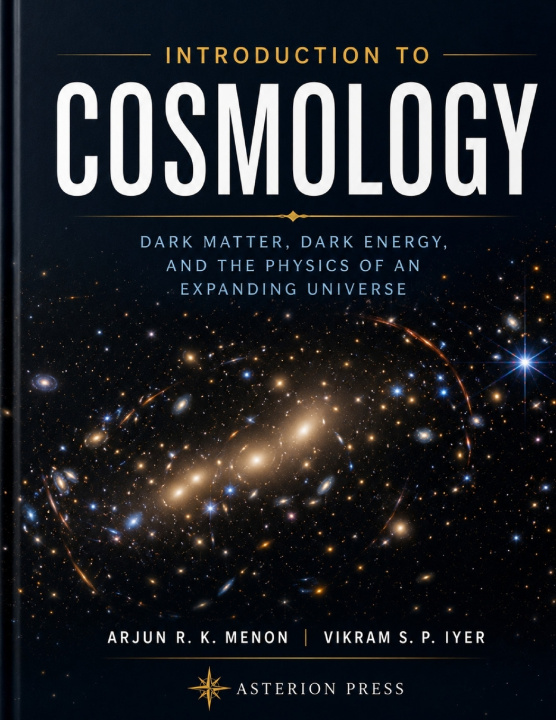
INTRODUCTION TO COSMOLOGY
Dark Matter, Dark Energy, and the Physics of an Expanding Universe
 Английски език
 154 b
154 b
 Нови
Нови
До 30 дни за връщане на стоки

The universe is now measured to a few percent - and the very precision that fixed its ingredients has opened cracks that older introductions never mention. This first course teaches the settled science, then carries you to its living frontier.
Newcomers to cosmology face a frustrating choice. Popular books explain the big ideas but hide the mathematics, so you cannot reproduce a single result; research-level texts assume you already command general relativity and the physics of the early universe. What is missing is a course that derives the standard model of the cosmos honestly, from the physics you already know, and then shows you the questions researchers are still arguing about.
This book closes that gap. It develops physical cosmology from first principles for readers who have completed the first two years of a physics or astronomy degree - calculus, mechanics, electromagnetism, statistical mechanics, and quantum physics - assuming no prior general relativity, which is introduced only as far as the subject needs. Every derivation starts from stated assumptions, every worked example carries its units to the end, and every value is drawn from the current published literature, so you learn not only to reproduce standard results but to read a current research paper and understand what is at stake.
Inside this book you will:
- Follow complete, step-by-step derivations of the equations of cosmic expansion instead of accepting results on faith.
- Rework fully solved examples and test yourself on end-of-chapter problems whose answers can be reproduced from the text.
- Build the standard six-number picture of a flat, expanding universe dominated by dark matter and dark energy, and see where each figure comes from.
- Learn just enough general relativity to handle curved and expanding space and the horizon of the observable universe.
- Understand how the relic radiation of the hot early universe, the light elements, and the growth of galaxies give independent evidence for one model.
- Use extensive reference material - constants, key equations, a glossary, and selected derivations - as a working companion beyond a first read.
- Reach the current frontier, where measurements of the expansion rate and the clustering of matter no longer fully agree.
Key topics include the expanding universe, redshift, and the scale factor; the essentials of general relativity and curved spacetime; cosmic dynamics and its solutions for matter, radiation, and dark energy; the distance ladder and the present-day expansion rate; dark matter; the cosmic microwave background; the synthesis of the light elements; inflation; linear and nonlinear structure formation; dark energy and cosmic acceleration; galaxies and cosmic dawn; the frontier tensions; and the matter-antimatter asymmetry.
It is written for advanced undergraduates in physics and astronomy meeting cosmology for the first time, for beginning graduate students who want a derivation-first foundation, and for self-directed learners with the necessary mathematics who want to move beyond popular accounts to the real calculations.
Open this comprehensive guide and start building cosmology the way it is actually done - from clear assumptions, through complete derivations, to the open questions defining the field today.


Информация за книгата
Английски език

Подарете тази книга днес
Лесно е
1 Добавете книгата в количката си и изберете Доставка като подарък 2 В замяна ще ви изпратим ваучер 3 Книгата ще пристигне на адреса на получателяЗдравейте! Аз съм Libroamiko, вашият книжен съветник.
Как мога да ви помогна?