
 Контакт
 Как се пазарува?

Доставка
Наръчник за пазаруване
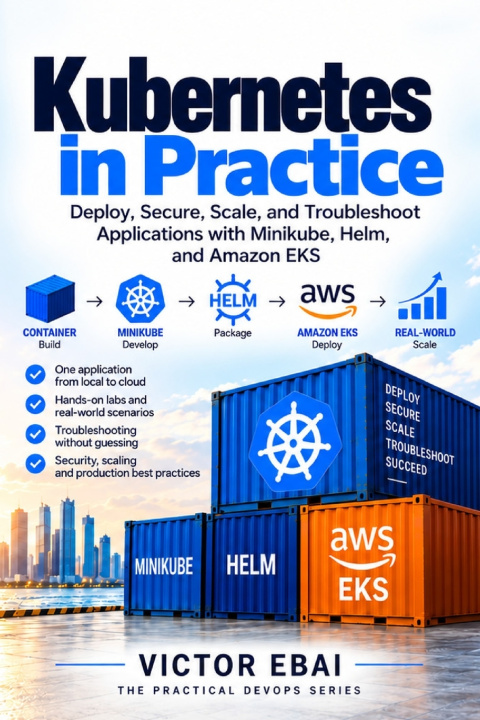
Kubernetes in Practice
Build, Operate, Troubleshoot, and Secure Kubernetes Applications with Confidence
 Английски език
 64 b
 Нови
До 30 дни за връщане на стоки

Running a container is one thing. Operating applications reliably on Kubernetes requires a deeper understanding of how the platform behaves.
Kubernetes gives you powerful mechanisms for deployment, recovery, networking, scaling, security, and application operation. The real challenge is understanding how those mechanisms work together, what evidence they produce, and where to look when the system does not behave as expected.
Kubernetes in Practice takes you from containerised applications to production-style Kubernetes operation through one practical application that develops throughout the book.
Instead of treating Kubernetes as a collection of YAML files and kubectl commands, the book builds a mental model of declared state, reconciliation, ownership, resource relationships, request paths, security boundaries, and observable evidence.
You learn by building workloads, observing their behaviour, deliberately introducing failures, diagnosing the evidence, applying the smallest justified correction, and verifying the result.
Through practical explanations and hands-on exercises, you will learn how to:
- Understand how Pods, Deployments, ReplicaSets, Services, and EndpointSlices work together
- Deploy applications with controlled updates, reconciliation, and failure recovery
- Build stable application networking with Services and Kubernetes DNS
- Manage application configuration and sensitive values appropriately
- Design startup, readiness, and liveness probes around actual application behaviour
- Apply resource controls and horizontal autoscaling
- Harden workloads with security contexts, ServiceAccounts, RBAC, Pod Security, and NetworkPolicy
- Troubleshoot Kubernetes systematically by following evidence across the request and resource paths
- Package repeatable application releases with Helm
- Move the same application from local Kubernetes to Amazon EKS
- Evaluate production concerns including identity, networking, reliability, observability, upgrades, cost, and cleanup
- Bring the complete operating model together in a production-style capstone
The book is designed for software developers, DevOps and platform engineers, cloud engineers, system administrators, support engineers, and students who understand basic containers and want to develop practical Kubernetes skills.
No previous Kubernetes, Minikube, kubectl, Helm, or Amazon EKS experience is required. Basic familiarity with Linux, containers, AWS fundamentals, and YAML is expected. These prerequisites reflect what the manuscript itself establishes for readers.
By the end, you will have moved beyond asking, "Which Kubernetes command should I run?" You will be able to reason about an application's state, understand how Kubernetes resources relate, gather evidence at the failing boundary, and verify that a correction repaired the original requirement.
Declare the state. Observe the system. Diagnose the evidence. Fix the boundary. Verify the result.


Информация за книгата
Английски език

Подарете тази книга днес
Лесно е
1 Добавете книгата в количката си и изберете Доставка като подарък 2 В замяна ще ви изпратим ваучер 3 Книгата ще пристигне на адреса на получателяЗдравейте! Аз съм Libroamiko, вашият книжен съветник.
Как мога да ви помогна?