
 Контакт
 Как се пазарува?
Доставка
Наръчник за пазаруване
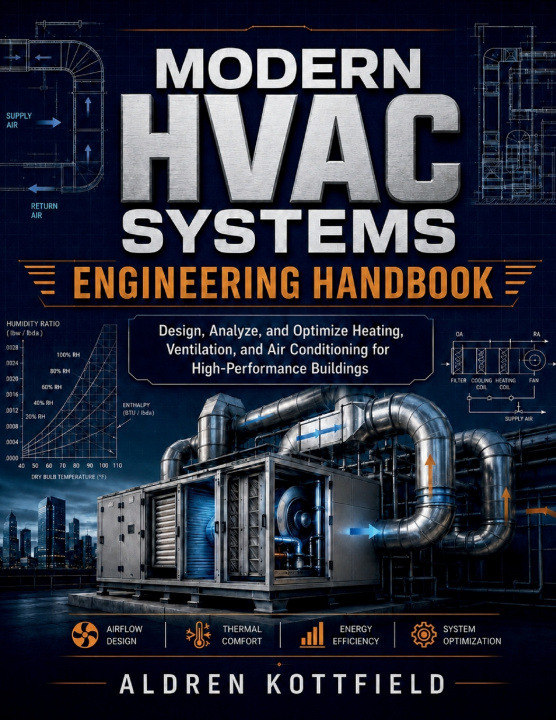
Modern HVAC Systems Engineering Handbook
Design, Analyze, and Optimize Heating, Ventilation, and Air Conditioning for High-Performance Buildings
 Английски език
 270 b
270 b
 Подготвяме
 Нови
Нови
До 30 дни за връщане на стоки

Turn HVAC theory into buildings that actually perform.
Every HVAC design begins with a simple demand and a hard reality: keep indoor air comfortable, healthy, and efficient while the weather outside swings by tens of degrees - and an equation you cannot run on real numbers is one you do not truly own.
Thermodynamics, fluid mechanics, heat transfer, controls, human comfort, and building codes all press on a single design decision at once, usually while a schedule runs. Many references stop at tidy theory or hand over rules of thumb without the reasoning, leaving engineers to bridge the gap between the classroom and a commissioned building alone.
This handbook closes that gap. It develops every method from first principles and carries it through complete, unit-tracked calculations - from the physics of a single air process to a fully commissioned, maintainable system - so you can execute the work, not just recognize it.
Inside, you will:
Build integrated fluency that links comfort targets, load calculations, equipment selection, and control logic instead of treating them as separate subjects.
Follow fully worked examples that show every step, with end-of-chapter practice problems and boxed answer keys to check your own work.
Calculate loads, size and select equipment, and lay out air and water distribution with methods you can apply directly to your projects.
Analyze refrigeration cycles, chilled-water plants, and heat-pump systems, and read the performance numbers that separate an efficient design from a wasteful one.
Design and sequence controls, then quantify energy use, life-cycle cost, and efficiency savings in defensible terms.
Work in both inch-pound and SI units, following current United States practice throughout.
Carry a design through ventilation, commissioning, testing and balancing, and troubleshooting - where real buildings succeed or fail.
Key topics: thermal comfort and psychrometrics; envelope heat transfer and heating and cooling load calculations; refrigeration cycles, refrigerants, and the low-GWP refrigerant transition; duct design, fans, and pumps; boilers, hydronics, and radiant heating; chilled-water plants and cooling towers; ventilation, filtration, and indoor air quality; air-handling units and terminal equipment; controls and building automation; energy efficiency and life-cycle cost; heat pumps and emerging low-carbon technologies; and whole-system design integration, commissioning, and maintenance - supported by extensive reference appendices and a complete building design example.
Who it is for: practicing mechanical and building-services engineers, engineers moving into HVAC from adjacent fields, and advanced engineering students who have completed introductory thermodynamics and fluid mechanics. Read in sequence it works as a course; consulted by chapter, it serves as a dependable working reference.
Open the handbook and start building the integrated, calculation-ready understanding that turns HVAC theory into buildings that perform.


Информация за книгата
Английски език

Подарете тази книга днес
Лесно е
1 Добавете книгата в количката си и изберете Доставка като подарък 2 В замяна ще ви изпратим ваучер 3 Книгата ще пристигне на адреса на получателяЗдравейте! Аз съм Libroamiko, вашият книжен съветник.
Как мога да ви помогна?