
 Контакт
 Как се пазарува?
Доставка
Наръчник за пазаруване
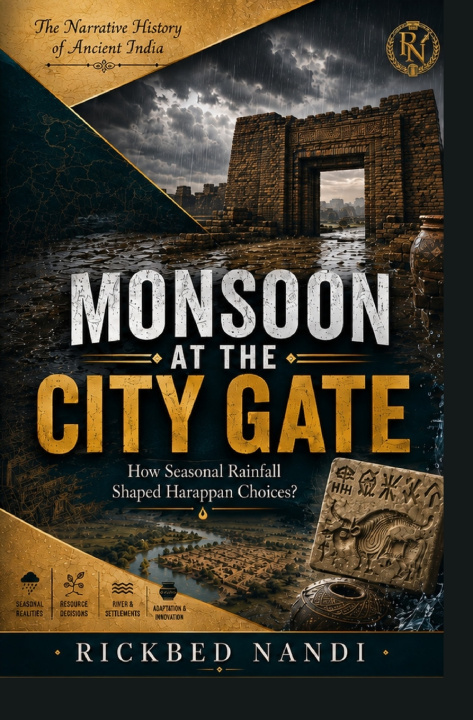
MONSOON AT THE CITY GATE
How Seasonal Rainfall Shaped Harappan Choices?
 Английски език
 43 b
43 b
 Нови
Нови
До 30 дни за връщане на стоки

A NOTE TO READERS
This is a book about weather and the decisions people made because of it.
That sentence looks small. It is not. Weather is the most ordinary thing in the world and the least escapable, and for most of human history the question of whether it would rain enough, and at the right time, was the question on which everything else in a life was balanced - whether a family ate, whether a village held together, whether a city was worth building where someone proposed to build it. We have spent a century recovering the Indus or Harappan civilisation from the ground, and for most of that century we described it as an achievement in bricks. It was. But the bricks were an answer, and the question that produced them fell out of the sky.
A word about what follows and how to use it.
The book is written for the general reader, which means I have assumed you know nothing in particular about South Asian archaeology and everything in general about being a person who has stood in the rain. I have not simplified the science; I have simply refused to hide behind it. Where a technical term is genuinely useful - avulsion, speleothem, rabi and kharif, de-urbanisation - I introduce it once, plainly, and then use it, because a reader who is trusted with a word is a reader who can go and read further.
I have leaned hard on figures. There are more than seventy of them, and they are not decoration. Some are maps, some are cross-sections, some are graphs, some are drawn arguments. A river's behaviour, a well's construction, a drainage cascade, the shape of a settlement hierarchy before and after a crisis - these are things prose describes badly and a line drawing describes at once. Where a figure carries the point, I have let it, and kept the surrounding text short. The tables are there for the same reason: a table is what you make when the honest answer is a list of numbers with uncertainties attached.
Three warnings, offered up front rather than smuggled in later.
The first is about dates. Archaeological dates are ranges, not points. When I write that the Mature Harappan period ran from about 2600 to about 1900 BCE, I am compressing thousands of radiocarbon measurements, each with its own error, into a convenient shorthand. Every "about" in this book is load-bearing.
The second is about causes. The temptation in a book like this is enormous: to line up a climate curve and a settlement curve, observe that they bend at roughly the same moment, and declare the case closed. I have tried very hard not to do that. Correlation in the Bronze Age is exactly as untrustworthy as correlation anywhere else, and the scholars who know this material best - I will name them as we go - have spent the last decade arguing, persuasively, that the story is more interesting than a drought and a collapse.
The third is about politics. The Indus civilisation sits inside two modern nation-states with a difficult relationship, and one of its rivers has become an object of intense nationalist feeling. I have tried to report what the peer-reviewed evidence says, to name the places where it is genuinely contested, and to leave the flag-waving to others. Where I have a view, I say so and say why.
One last thing. There are moments in this story where the evidence simply stops, and I have resisted the urge to paper over them. We do not know what language these people spoke. We do not know what their writing says. We do not know who, if anyone, ruled them, or what they believed happened after death, or why they built an enormous waterproof tank on the highest ground in their greatest city. A book that pretended otherwise would be a worse book.


Информация за книгата
Английски език

Подарете тази книга днес
Лесно е
1 Добавете книгата в количката си и изберете Доставка като подарък 2 В замяна ще ви изпратим ваучер 3 Книгата ще пристигне на адреса на получателяЗдравейте! Аз съм Libroamiko, вашият книжен съветник.
Как мога да ви помогна?