
 Контакт
 Как се пазарува?
Доставка
Наръчник за пазаруване
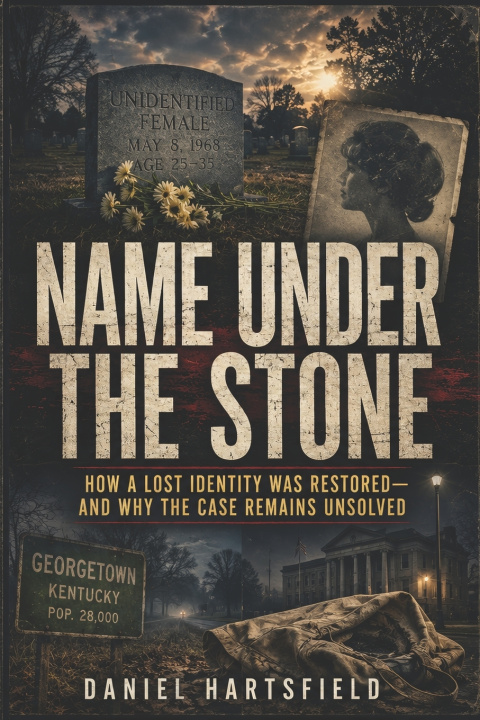
Name Under the Stone
How a Lost Identity Was Restored-and Why the Case Remains Unsolved
 Английски език
 45 b
45 b
 Нови
Нови
До 30 дни за връщане на стоки

For nearly thirty years, a Kentucky homicide victim had a public nickname-but no name of her own.
Name Under the Stone is a historical true crime investigation into the case of Barbara Ann "Bobbie" Hackmann Taylor, the young mother who disappeared from Lexington, Kentucky, in late 1967 and was later identified as the woman found near U.S. Route 25 north of Georgetown in May 1968. Buried for years as "Tent Girl," she remained unidentified until DNA testing in 1998 restored the name her family had been missing.
The book follows two records that failed to meet for decades: a missing woman in Lexington and an unidentified homicide victim in Georgetown. It examines the discovery of the body, the heavy material in which she was found, the early physical description, the disputed age estimate, the limits of the original investigation, and the long period in which a practical case label became more familiar than the person it described.
At the center of the identification is the persistence of Todd Matthews, whose search connected the unidentified woman to Barbara's family. The account traces the comparison of photographs and physical details, the exhumation of the Georgetown grave, the use of teeth, bone, and family DNA, and the 1998 confirmation that returned Barbara Ann Hackmann Taylor to the public record.
Identification, however, did not solve the homicide. Public reporting later identified Barbara's husband, George Earl Taylor, as the principal suspect, but he died before Barbara was identified and was never charged or tried. This book preserves that distinction. It examines the reported reasons investigators focused on him while separating suspicion, circumstantial inference, and later theory from any legal finding of guilt.
The case also opens a wider question about how missing-person and unidentified-remains records were once separated by geography, paper files, inaccurate estimates, and the absence of a national matching system. Through Barbara's story, the book considers the early role of online searching and the larger movement toward connecting families, investigators, and unidentified decedent records.
Written as evidence-aware narrative nonfiction, Name Under the Stone avoids invented dialogue, graphic sensationalism, and false certainty. It follows documented chronology, conflicting public accounts, forensic limits, and the difference between restoring identity and proving responsibility. The result is a cold case book about historical true crime, missing persons, forensic identification, public memory, and the questions that remain when science can name the victim but the evidence cannot produce a verdict.
For readers drawn to unsolved homicide investigations and the history of identifying the unknown, this is an account centered on Barbara's restored name-and on the boundary between what the record can establish and what it cannot.


Информация за книгата
Английски език
Категории

Подарете тази книга днес
Лесно е
1 Добавете книгата в количката си и изберете Доставка като подарък 2 В замяна ще ви изпратим ваучер 3 Книгата ще пристигне на адреса на получателяЗдравейте! Аз съм Libroamiko, вашият книжен съветник.
Как мога да ви помогна?