
 Контакт
 Как се пазарува?
Доставка
Наръчник за пазаруване
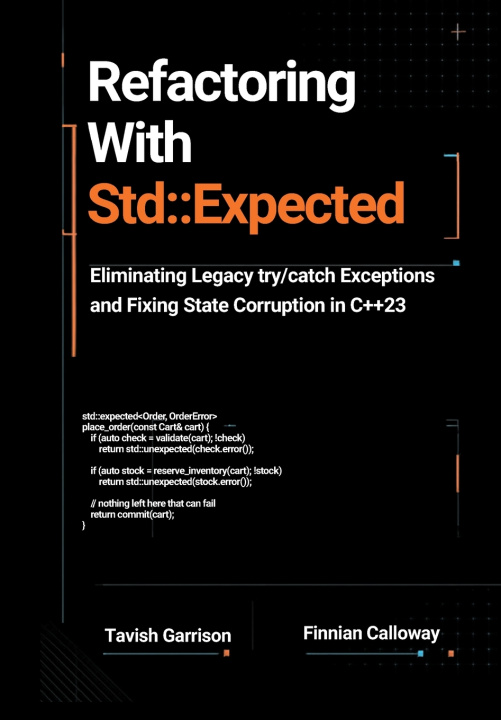
Refactoring With std
:expected: Eliminating Legacy try/catch Exceptions and Fixing State Corruption in C++23
 Английски език
 70 b
70 b
 Подготвяме
 Нови
Нови
До 30 дни за връщане на стоки

Your Migration To std::expected Compiled Clean. The Corruption Shipped Anyway.
A function can return std::expected check has_value() everywhere a reviewer can see, pass every test in the suite, and still corrupt an account balance or leave an order half reserved in production, because nothing about a clean type signature tells you the mutation on line four ran before the validation on line seven. Migrating off exceptions does not, by itself, fix a single one of the bugs exceptions were blamed for.
Most engineers treat expected as a safer syntax for the same error handling they already had. It is not. A thrown exception and a returned std::unexpected fail at different points in a program's execution, with different costs and consequences the moment a call site skips a check it was supposed to make. A seam between legacy exception code and expected returning code can silently flatten six distinct failure types into one generic error, discarding the exact field an on call engineer needs during an incident.
Refactoring With std::expected is a strictly technical, mechanism first field guide for C++ engineers who already have expected in their codebase and need to diagnose why a properly typed, fully checked refactor still produced a corrupted object or an incident nobody could trace back to its cause.
Through precise ordering discipline, real boundary code, and a field tested diagnostic flow, you will learn to build functions where failure cannot leave partial state behind, and to catch a leaking seam or an unchecked access before it reaches production.
Inside the Book, You Will Diagnose and Fix:
Hidden Control Flow: Why a function's own type signature lies about its failure modes the moment a throw sits anywhere inside its call chain.
State Corruption From Partial Success: Build functions using the stage then commit pattern, where every fallible operation runs against local values before shared state gets mutated.
Exception and expected Boundary Leaks: The exact two shapes a correct seam takes at the point legacy throwing code meets expected returning code, and the conversions that silently drop context.
Unchecked Access Failures: Why an unguarded .value() call fails worse than the exception it replaced, including builds where it terminates with no diagnostic.
Monadic Chains That Hide Branching: Read an and_then chain the way it executes, and catch the inline lambda quietly running three code paths behind one flat step.
Error Type Composition: Choose between a flat enum, a rich struct, a variant composite, and std::error_code based on what your callers need to act on.
A Full Migration End to End: Triage which throw sites are worth converting, sequence the conversion so the codebase compiles at every step, and know which exceptions should stay as they are.
Stop trusting a checked expected and a passing test suite as proof your error handling is correct. This book gives you the reasoning, code, and diagnostic checklist to know the difference between visible failure and clean failure.
Who this book is for: senior C++ engineers, systems developers, and technical leads who already use or are migrating to std::expected and need to move from "it compiles" to verifying ordering, boundary, and access correctness. It assumes working knowledge of modern C++. Not an introduction for beginners.
Scroll up and click "Buy Now" to catch your state corruption before an incident review finds it for you.


Информация за книгата
Английски език
