
 Контакт
 Как се пазарува?
Доставка
Наръчник за пазаруване
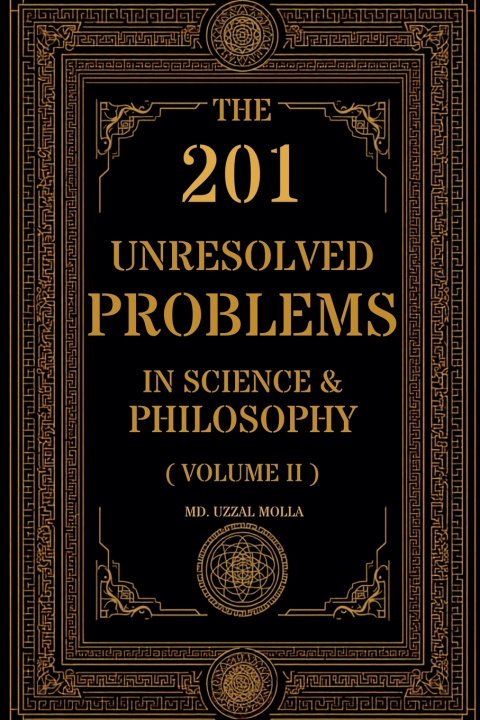
The 201 Unresolved Problems in Science and Philosophy
Volume II: Quantum Foundations & Observation
 Английски език
 32 b
32 b
 Подготвяме
 Нови
Нови
До 30 дни за връщане на стоки

The 201 Unresolved Problems in Science and Philosophy: Volume II-Quantum Foundations & Observation investigates some of the deepest unresolved questions at the foundations of modern physics and philosophy. It examines the quantum measurement problem, superposition, wave-function collapse, decoherence, entanglement, nonlocality, contextuality, probability, causality, quantum information, realism, and the role of the observer in determining what can be physically known and described.
Building upon the Unified Principle framework, this volume approaches these problems not as isolated paradoxes but as interconnected expressions of a deeper structural relationship among Laws, Events, Observers, and structural constraints. It asks how lawful possibilities become definite physical events, how quantum states should be interpreted, whether observation is merely the registration of an existing reality or part of a structured physical relation, and how information connects mathematical description with empirical actuality.
Particular attention is given to the distinction between possibility and actuality, correlation and causation, observation and measurement, and mathematical formalism and ontological reality. The volume examines whether quantum mechanics requires a fundamentally observer-dependent conception of reality or whether observer-dependence can instead be understood as a lawful relational feature of physical systems. Entanglement and contextuality are explored as challenges to classical assumptions concerning separability and predetermined properties, while decoherence is examined in relation to the emergence of classical behavior and the continuing question of definite outcomes.
The book also investigates the philosophical status of quantum probability and information. It asks whether probability represents incomplete knowledge, objective physical possibility, relational information, or a deeper structural feature of reality. Similarly, it explores whether information should be regarded merely as a description of physical systems or as a fundamental component of their relational organization.
Rather than replacing established quantum theory, this volume seeks to provide a conceptual architecture through which its foundational problems can be systematically interpreted. The Unified Principle perspective proposes that quantum reality becomes more intelligible when laws, possible states, physical events, observational conditions, information, and structural relations are considered together rather than independently.
As the second volume of The 201 Unresolved Problems in Science and Philosophy, this work advances the larger project of developing a coherent framework for understanding knowledge, existence, reality, and meaning. It is intended for scientists, philosophers, researchers, graduate students, and readers interested in the deepest conceptual questions raised by quantum physics and the nature of observation.
At its core, the volume asks a fundamental question: What structure of reality would make quantum phenomena, observation, information, and physical knowledge parts of one coherent whole?


Информация за книгата
Английски език
