
 Контакт
 Как се пазарува?
Доставка
Наръчник за пазаруване
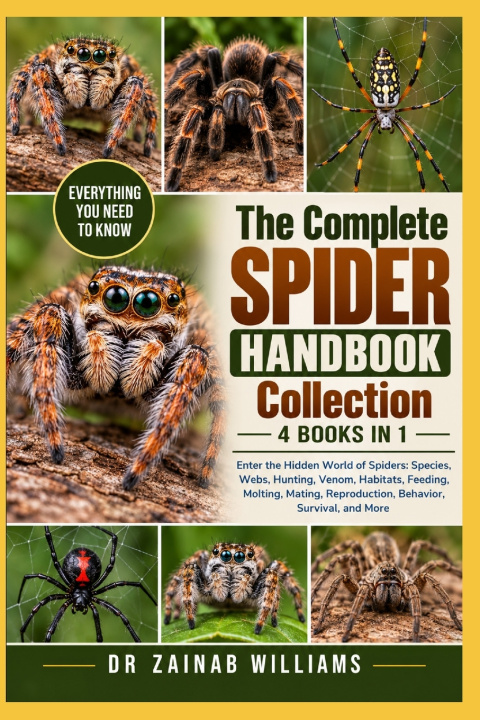
The Complete Spider Handbook Collection - 4 Books in 1
Enter the Hidden World of Spiders: Species, Webs, Hunting, Venom, Habitats, Feeding, Molting, Mating, Reproduction, Behavior, Survival, and
 Английски език
 42 b
42 b
 Подготвяме
 Нови
Нови
До 30 дни за връщане на стоки

K
eeping spiders successfully begins with understanding what they
actually need rather than trying to make every species fit the
same care routine. A tiny jumping spider living among leaves
and branches has very different requirements from a large ground-dwelling
hunter, a web-building orb-weaver, or a secretive burrowing species. Even
spiders that appear similar may differ considerably in enclosure design,
moisture needs, feeding behavior, activity patterns, and tolerance for
disturbance.
The Complete Spider Handbook Collection - 4 Books in 1 is designed to
help readers approach spider care with patience, preparation, observation,
and respect. It brings together practical principles that can be adapted to
many types of spiders, including jumping spiders, wolf spiders, orb-weavers,
trapdoor spiders, huntsman spiders, fishing spiders, golden silk orb-weavers,
mouse spiders, redbacks, recluse spiders, widow spiders, peacock spiders,
funnel-web spiders, lynx spiders, and many other species.
The goal is not simply to keep a spider alive. Responsible care means
creating conditions that allow an animal to express appropriate natural
behaviors while minimizing unnecessary stress, injury, escape risks, and
environmental problems. Good husbandry is built through consistent
routines and careful observation. The more closely you learn to notice
what your spider is doing, the easier it becomes to recognize its normal
patterns and respond appropriately when something changes.
1.1 Understanding the Purpose, Scope, and Main Promise of
The Complete Spider Handbook Collection - 4 Books in 1
This handbook is intended to serve as a practical reference for people at
different experience levels. A person seeing their first jumping spider may
need help understanding enclosure design and feeding routines. An experienced keeper may instead be comparing the environmental requirements
of several species or improving record-keeping and maintenance routines.
Both benefit from the same basic principle: care should be adapted to the
individual animal and its species.
The handbook therefore emphasizes practical decision-making rather
than one-size-fits-all instructions.
Before acquiring a spider, begin by identifying the species as accurately as
possible. Common names can sometimes refer to several related animals,
and different species may have substantially different requirements. If the
exact species is uncertain, avoid assuming that a care sheet for a visually
similar spider automatically applies.
A useful preparation process is:
1. Identify the spider as accurately as possible.
2. Learn whether it is primarily arboreal, terrestrial, burrowing,
web-building, or associated with water.
3. Determine its expected adult size and activity pattern.
4. Research its environmental requirements before setting up the
enclosure.
5. Prepare the enclosure before bringing the animal home.
6. Establish a feeding and observation routine.
The Complete Spider Handbook Collection - 4 Books in 1
7. Plan for escape prevention and household safety.
8. Know in advance who to contact if the animal becomes injured
or its condition changes significantly


Информация за книгата
Английски език

Подарете тази книга днес
Лесно е
1 Добавете книгата в количката си и изберете Доставка като подарък 2 В замяна ще ви изпратим ваучер 3 Книгата ще пристигне на адреса на получателяЗдравейте! Аз съм Libroamiko, вашият книжен съветник.
Как мога да ви помогна?