
 Контакт
 Как се пазарува?

Доставка
Наръчник за пазаруване
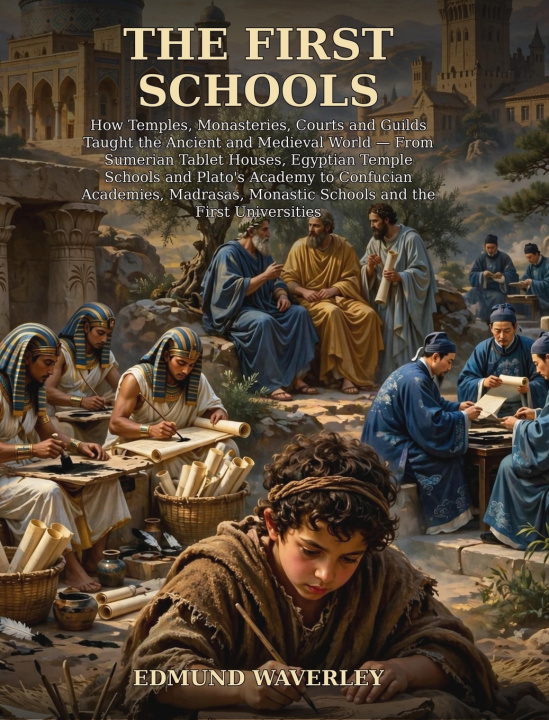
The First Schools
How Temples, Monasteries, Courts and Guilds Taught the Ancient and Medieval World - From Sumerian Tablet Houses, Egyptian Temple Schools and Plato's Academy to Confucian Academies, Madrasas, Monastic Schools and the First Universities
 Английски език
 112 b
 Нови
До 30 дни за връщане на стоки

Before the university, there was the tablet house - and every school since has copied it.
The first schools were not built for everyone, and that is exactly what makes their story honest. In Sumer, a boy spent long days pressing cuneiform wedges into clay so an empire could keep its accounts. In Egypt, temple scribes copied medical and magical texts in the House of Life and guarded them like treasure. Greek boys wrestled and read in the gymnasium, sophists sold rhetoric to anyone who could pay, and Plato and Aristotle founded schools in a grove and a colonnade that outlived them by centuries. Rome caned its grammar pupils and then produced Quintilian, who argued - in the first century - that beating children was a bad way to teach.
The First Schools tells that whole story in forty chapters - one school, tradition, teacher or institution at a time, across five continents of the ancient and medieval world. China built an imperial academy and examined its scholars. India taught at the guru's house, at Taxila, and at Nalanda, where Chinese pilgrims crossed deserts to study. Baghdad endowed the Nizamiyya with salaried professors and student stipends. Monks taught psalms by heart in desert cells and Irish monasteries; cathedral schools became Bologna, Paris and Oxford; merchants sent their sons to abacus masters; and the record - fragmentary, unfair, but real - preserves the girls and women who learned anyway.
Inside you will discover:
- What a school day actually looked like in the Sumerian edubba - timetable, examinations, punishments and all
- How Plato's Academy and Aristotle's Lyceum worked, and why they lasted for centuries
- How China moved from Confucius's travelling school to imperial academies and the Hanlin
- What Xuanzang and Yijing really reported about Nalanda - and what later retellings added
- How the waqf endowment paid for madrasas, stipends and libraries across the Islamic world
- How cathedral schools became universities - and why students at Bologna could fine their professors
- Who was kept out: the honest record of girls, the poor and the enslaved in ancient education
Who this book is for
For readers of ancient and medieval history, teachers, parents and the incurably curious - anyone who has ever sat in a classroom and wondered who invented the room, the timetable, the curriculum and the examination. Almost everything in a modern school was invented once, by someone in this book.


Информация за книгата
Английски език

Подарете тази книга днес
Лесно е
1 Добавете книгата в количката си и изберете Доставка като подарък 2 В замяна ще ви изпратим ваучер 3 Книгата ще пристигне на адреса на получателяЗдравейте! Аз съм Libroamiko, вашият книжен съветник.
Как мога да ви помогна?