
 Контакт
 Как се пазарува?
Доставка
Наръчник за пазаруване
 Английски език
 56 b
56 b
 Нови
Нови
До 30 дни за връщане на стоки

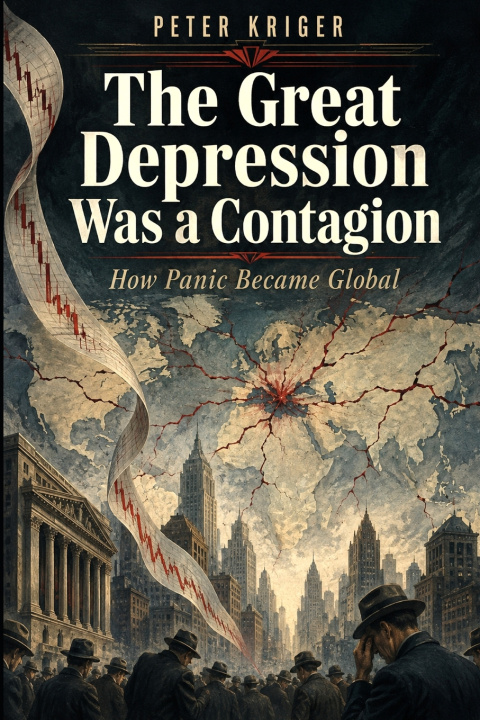
In October 1929, share prices fell in New York. Within twenty months, an Austrian bank nobody outside Vienna could spell had taken down the German banking system, the pound sterling had abandoned a promise it had kept for two centuries, and farmers in Saskatchewan were burning wheat they could not sell to people in Shanghai who could not buy it. The usual explanation is that a very large thing happened in America and the world felt it. That explanation is comforting, tidy, and wrong.
The Great Depression did not radiate outward from a single wound. It spread. It had carriers, contact networks, incubation periods, superspreading events, quarantines that worked, quarantines that came too late, and a rather effective vaccine that most governments refused to take until their own citizens were queueing outside the banks. The countries that broke the chain of transmission early recovered early. The countries that stayed loyal to the network stayed sick. This pattern is so consistent that if it appeared in a medical journal, nobody would argue about it. It appears in economic history instead, so people have been arguing about it for ninety years.
This book takes the epidemiological metaphor seriously enough to test it, and then honest enough to say where it breaks. It maps the contact graph of the world economy in 1929 - the correspondent banks stacked on top of each other like an unwise game of Jenga, the short-term credits rolled over every ninety days by men who assumed they always would be, the gold standard welding thirty-odd national economies into one rigid machine with no shock absorbers and a great deal of moral prestige. It follows the infection through Vienna, Berlin, London, New York, Tokyo, Buenos Aires, and the Mississippi Delta, where an accident of Federal Reserve district boundaries ran the closest thing history has offered to a controlled experiment on bank panics.
Along the way it explains why the tariff everyone blames was the least of it, why deflation and not unemployment predicted who voted for the far right, why Sweden quietly did everything correctly and nobody noticed, and why the central bankers of the era were not fools but doctors practicing before germ theory - confident, sincere, well dressed, and killing the patient with the best intentions in the world.
It also asks the uncomfortable modern question. We built firebreaks after 1933 and rebuilt them after 2008. But the network has grown faster than the firebreaks, and in 2023 a bank died in thirty-six hours because panic now travels at the speed of a group chat. We are better protected against the last contagion than anyone in 1931 was. Whether that is the same as being protected is the subject of the final chapters.
A book about the worst decade in modern economic history that is, against all reasonable expectation, quite good company.
Keywords: Great Depression, financial contagion, gold standard, banking panic, Creditanstalt, Danatbank, sterling crisis 1931, Smoot-Hawley, debt deflation, correspondent banking, sudden stop, capital controls, Federal Reserve, Bank of England, Reichsbank, Banque de France, gold sterilization, Irving Fisher, Ben Bernanke, Barry Eichengreen, Milton Friedman, Anna Schwartz, Takahashi Korekiyo, Montagu Norman, Hjalmar Schacht, bank runs, deposit insurance, lender of last resort, systemic risk, financial networks, complex systems, cascade failure, latency, economic history, interwar economy, 1929 crash, 1931 crisis, recovery, reflation, Sweden, Japan, Latin American default, fascism and deflation, 2008 financial crisis, Silicon Valley Bank, comparative economic history, popular economics


Информация за книгата
Английски език
Категории

Подарете тази книга днес
Лесно е
1 Добавете книгата в количката си и изберете Доставка като подарък 2 В замяна ще ви изпратим ваучер 3 Книгата ще пристигне на адреса на получателяЗдравейте! Аз съм Libroamiko, вашият книжен съветник.
Как мога да ви помогна?