
 Контакт
 Как се пазарува?
Доставка
Наръчник за пазаруване
 Английски език
 40 b
40 b
 Нови
Нови
30 дни за връщане на стоката

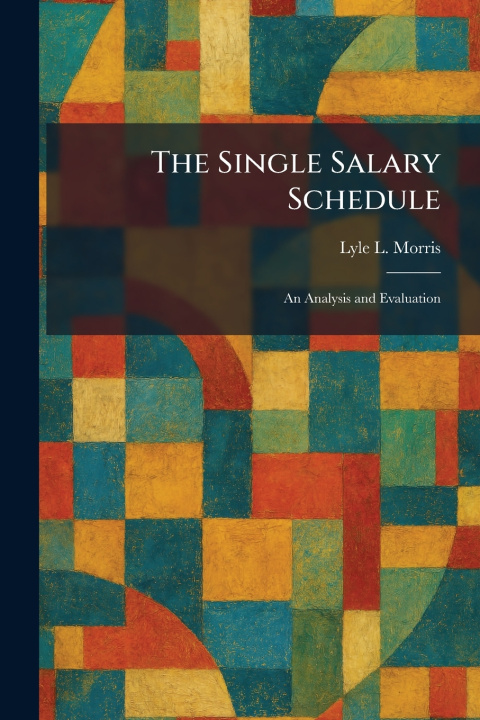
"The Single Salary Schedule: An Analysis and Evaluation" is a meticulous study of the administrative and economic structures governing teacher compensation in the early twentieth century. This academic work focuses on the transition toward uniform pay scales, analyzing how salary schedules based on educational qualifications and years of service-rather than specific grade assignments-affect the broader educational landscape.
Lyle L. Morris provides a rigorous evaluation of contemporary school systems, utilizing empirical data to assess the practical implementation of the single salary schedule. The text delves into the arguments for and against salary standardization, examining its influence on teacher recruitment, professional retention, and the overall quality of instruction. By exploring the relationship between financial incentives and professional standards, Morris offers a foundational look at the professionalization of teaching.
This work is a vital resource for those interested in the history of school finance and educational policy. It captures a pivotal moment in the development of American school administration, offering deep insights into the systemic reforms intended to promote equity and efficiency within the classroom. "The Single Salary Schedule: An Analysis and Evaluation" remains an essential historical document for understanding the evolution of teacher pay and the professional status of educators.
This work has been selected by scholars as being culturally important, and is part of the knowledge base of civilization as we know it. This work was reproduced from the original artifact, and remains as true to the original work as possible. Therefore, you may see the original copyright references, library stamps (as most of these works have been housed in our most important libraries around the world), and other notations in the work.
This work is in the public domain in the United States of America, and possibly other nations. Within the United States, you may freely copy and distribute this work, as no entity (individual or corporate) has a copyright on the body of the work.
As a reproduction of a historical artifact, this work may contain missing or blurred pages, poor pictures, errant marks, etc. Scholars believe, and we concur, that this work is important enough to be preserved, reproduced, and made generally available to the public. We appreciate your support of the preservation process, and thank you for being an important part of keeping this knowledge alive and relevant.


Информация за книгата
Английски език
