
 Контакт
 Как се пазарува?
Доставка
Наръчник за пазаруване
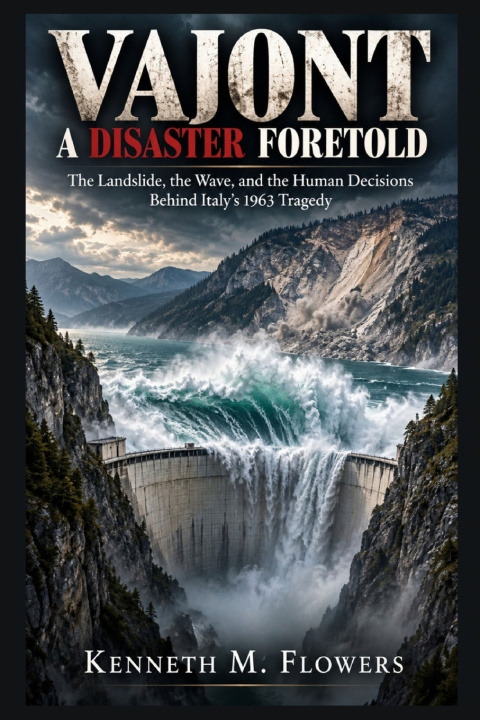
VAJONT
A DISASTER FORETOLD: The Landslide, the Wave, and the Human Decisions Behind Italy's 1963 Tragedy
 Английски език
 47 b
47 b
 Подготвяме
 Нови
Нови
До 30 дни за връщане на стоки

VAJONT: A DISASTER FORETOLD
The Landslide, the Wave, and the Human Decisions Behind Italy's 1963 Tragedy
What happens when one of the strongest dams in the world survives, but the communities beneath it do not?
On the night of October 9, 1963, a massive section of Monte Toc broke loose and crashed into the Vajont reservoir in northern Italy. Hundreds of millions of cubic metres of rock struck the water, sending an enormous wave over the dam and into the valley below. Within minutes, Longarone and nearby communities were devastated. Nearly two thousand people lost their lives.
Yet the dam itself remained standing.
VAJONT: A DISASTER FORETOLD tells the gripping true story of the Vajont Dam disaster, one of the most haunting tragedies of twentieth-century Europe. More than a simple account of the Vajont disaster 1963, this book examines the years of warning signs, scientific uncertainty, engineering confidence, and human decisions that came before the mountain finally fell.
At the center of the story is the Monte Toc landslide, a gigantic mass of unstable rock that had shown signs of movement long before the final collapse. Cracks appeared across the mountain. Smaller slides occurred. Measurements showed that the ground was moving. Experts debated what the mountain might do. Yet the reservoir remained beneath it.
When the slope finally failed, the result became known around the world as the Longarone disaster, a tragedy that transformed an ambitious hydroelectric project into an unforgettable Italy dam disaster.
This carefully researched account takes readers beyond the terrifying minutes of the 1963 Italian disaster and into the geology, engineering, politics, and personal choices behind it. Readers interested in deadly landslide history and major engineering disasters will discover how a project once praised as a technical achievement became a lasting warning about risk and responsibility.
The story also belongs beside the most important examples of engineering failures history, even though the concrete dam itself did not collapse. Vajont challenges the usual understanding of dam failure disasters because the real danger came from the mountain surrounding the reservoir rather than the wall holding back the water.
For readers fascinated by historic dam disasters, man made disasters, and preventable disasters history, Vajont raises difficult questions. How much danger was understood before October 9? Why did confidence remain when the mountainside was already moving? Could more lives have been saved?
Through clear and accessible explanations, the book examines how the hydroelectric dam disaster developed into a deadly reservoir landslide disaster. It explains how water pressure, weak rock layers, an ancient sliding surface, and changes in reservoir levels contributed to conditions on Monte Toc.
Vajont also offers one of history's most important studies of catastrophic landslides, civil engineering failures, and geological disasters. The tragedy shows why engineers must look beyond the structure they are building and understand the wider natural system surrounding it.
Readers who enjoy compelling disaster history books, deeply researched historical catastrophes, or accounts of industrial disasters history will find a story filled with questions that remain relevant today.


Информация за книгата
Английски език

Подарете тази книга днес
Лесно е
1 Добавете книгата в количката си и изберете Доставка като подарък 2 В замяна ще ви изпратим ваучер 3 Книгата ще пристигне на адреса на получателяЗдравейте! Аз съм Libroamiko, вашият книжен съветник.
Как мога да ви помогна?