Contact
 How to shop
Delivery
Shopping guide
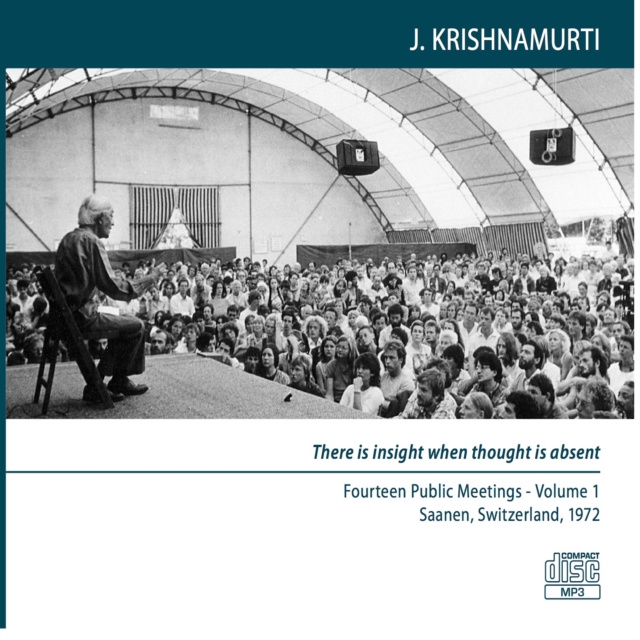
There Is insight when thought is absent
Fourteen public Meetings Saanen Switzerland 1972
 English
 13 b
13 b
Customers also purchased











 /
/
 Paperback
 16.27
€
31.81 лв
16.27
€
31.81 лв

 /
Paperback
14.40
€
28.16 лв
/
Paperback
14.40
€
28.16 лв

Public Talks1. Can I see wholly? - 16 July 1972Duration: 71 minutes Do we act casually, expecting division to end as a result of outer environment? Does change demand immediate attention and action? Freeing of the mind from conditioning and in that freedom bringing about a cooperative action. Can one who is conditioned by the past change totally? Will change come through analysis or is there a totally different approach? Is time needed to have relationship in which there is love and not division? Does one of the many fragments of the 'me' assume authority or is the mind free to look? Observation not investigation. Is there analysis if there are no parts? Is analysis a waste of time?Questions from the audience followed the talk. 2. What is it to be creative? - 18 July 1972Duration: 76 minutes Not being deeply creative we escape from the fact of deep frustration. Is there insight only when the mind is free of belief? Insight without conclusion is creative action. Why does thought draw conclusions from insight and cling to the structure of control? I am isolated when I resist. Is aloneness insight into isolation? Moving in insight, relationship changes. Freedom from images is responsibility and love. The brain needs security to function. There is security in insight, which bringsintelligence. When you don't compare, what are you?Questions from the audience followed the talk3. Thought and its limitations - 20 July 1972Duration: 85 minutes Can thought investigate something which is not of time, experience and knowledge? What is the mind that can enter into the dimension which has no word? Can there be a harmony in which division does not exist between the known and freedom from the known? Is the mind such a slave to words that it cannot see the movement of thought without the word? Will knowledge bring about a better world when used with the 'me'? When the body dies what happens to thought? If I am aware that I am neurotic, in that awareness am I neurotic?Questions from the audience followed the talk4. Can the mind be totally unconditioned? - 23 July 1972Duration: 84 minutes Society, culture and economic divisions have created images in us. Can the deep hurts of the mind be wiped away so that no mark is left? Will this be done through analysis? Who is analysing? Is hurt a problem if you do not move away from it? Does conflict destroy the brain? Is comparison an escape from 'what is'? Am I the word, the description, the thought? If I don't compare, what am I? Wanting to cross to the other side of the river becomes a problem. Questions from the audience followed the talk5. Will the discovery of the cause of suffering end it? - 25 July 1972Duration: 83 minutes Is sorrow ignorance of oneself? How does one go beyond loneliness? Can thought as measurement put an end to itself? When belief is threatened there is fear. Can the brain have security in which every form of fear has come to an end? Can the mind realize there is no security in the things that thought projects? The perception of truth is security. Can the mind invite joy? Can one help another in crisis?Questions from the audience followed the talk6. Pleasure, joy and death - 27 July 1972Duration: 92 minutes Does the mind have any existence apart from the thing to which it is attached? Why does the mind act from a series of conclusions of thought? How can I love you if I am attached to you? What is the actual activity of the structure of memory which is the past? Can the mind have an insight into conditioning and therefore tremendous energy to change it? How do I communicate love without the word? Is there anything permanent beyond death?Questions from the audience followed the talk7. Religion and meditation - 30 July 1972Duration: 88 minutes Why have we divided life into spirit and matter? Is religion based on the insights of a few who have established a church? How is the mind to bring about harmony, tremendous energy and clarity? Will any act of desire bring it about? Is the controller different from the controlled? Why do you want any kind of experience? Can the mind and the brain be completely still? Can you know your mind is quiet? Quietness implies space. Is there something immeasurable beyond thought? What job will one do if one is serious about life?Questions from the audience followed the talkPublic Discussions8. The observer and the observed - 2 August 1972Duration: 93 minutes Q: How can I learn about myself? I want to learn about myself without conclusion because conclusion prevents looking at the fact. There is the observer and the thing observed. When there is an observer there must be division and conflict. I am not a harmonious whole, I am fragmented because I hate and love, I am ambitious and greedy. The observer is the cause of division. How is the observer not to divide himself? Can the mind respond totally to every cha ...


About the book
English
Categories

Give this book today
It's easy
1 Add to cart and choose Deliver as present at the checkout 2 We'll send you a voucher 3 The book will arrive at the recipient's addressYou might also be interested in


 /
Paperback
25.23
€
49.35 лв
/
Paperback
25.23
€
49.35 лв
 /
/
 MP3
15.13
€
29.58 лв
MP3
15.13
€
29.58 лв